
What Is a Tax Bracket & How It Affects Your Money in 2025 | lucasosoro.finance.blog
📊 What Is a Tax Bracket & How It Affects Your Money in 2025
By Lucas Osoro | lucasosoro.finance.blog
Whether you’re an employee, entrepreneur, freelancer, or investor, knowing how tax brackets work can help you legally lower your tax bill, maximize deductions, and make smarter financial decisions.
In this guide, we break down what a tax bracket really is, how it works in 2025, and how you can use that knowledge to build and protect your wealth.
💼 What Is a Tax Bracket?
A tax bracket is a range of income that gets taxed at a specific rate. The U.S. federal income tax system is progressive, meaning the more you earn, the higher the rate you pay on that portion of your income.
👉 But here’s the key: You’re only taxed at a higher rate on the income that falls into that higher bracket—not your entire income.
If you’re new to budgeting and tracking your income, check out our Budget & Wealth Builder Vault.
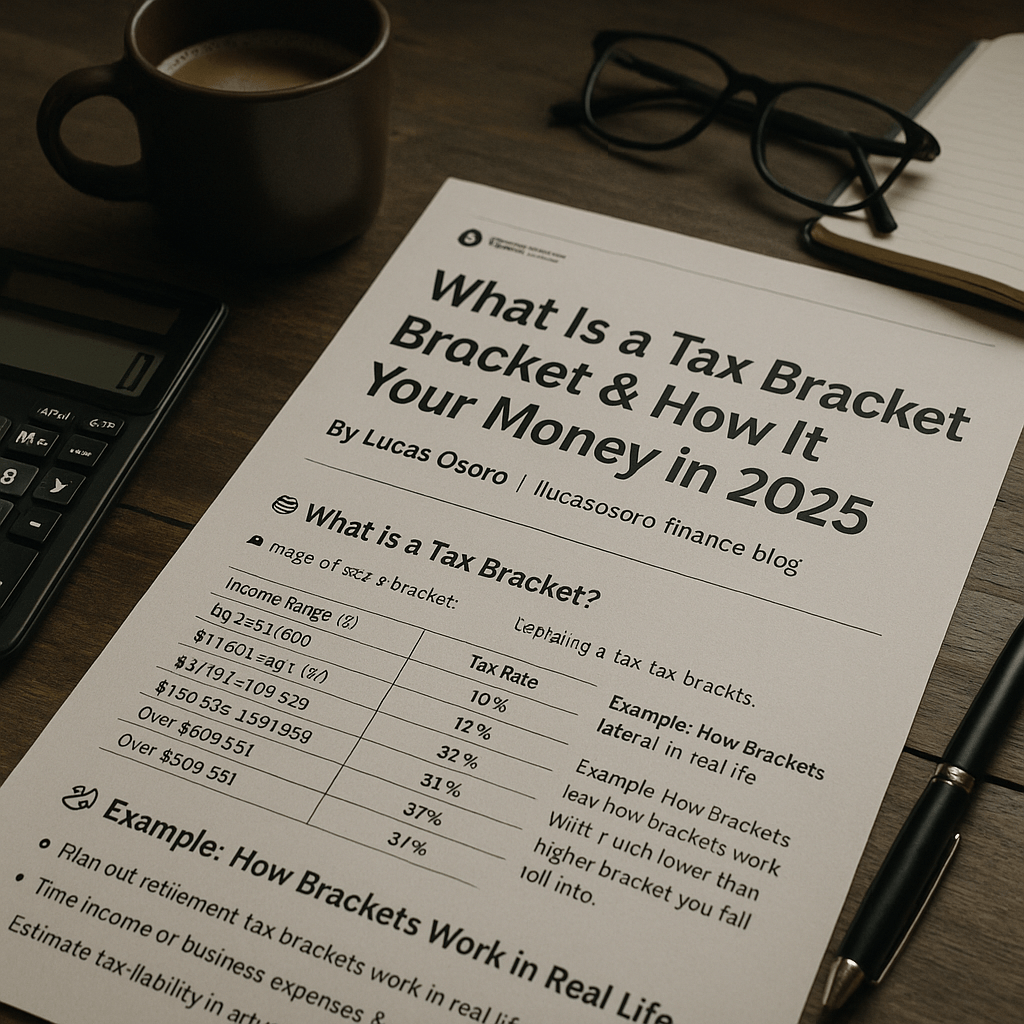
🧮 2025 Federal Income Tax Brackets (USA)
Here’s a simplified snapshot of how tax brackets work for single filers in 2025:
| Income Range ($) | Tax Rate |
|---|---|
| Up to $11,600 | 10% |
| $11,601 – $47,150 | 12% |
| $47,151 – $100,525 | 22% |
| $100,526 – $191,950 | 24% |
| $191,951 – $243,725 | 32% |
| $243,726 – $609,350 | 35% |
| Over $609,351 | 37% |
📌 Note: Brackets differ for married couples filing jointly, heads of household, and other statuses.
Looking to start investing before you move up the tax brackets? Read How to Start Investing with $50.
💡 Example: How Brackets Work in Real Life
Let’s say you earn $60,000 in 2025. Your tax is not simply 22% of the entire $60K.
Instead:
- The first $11,600 is taxed at 10%
- The next portion (up to $47,150) is taxed at 12%
- The final portion ($47,151 to $60,000) is taxed at 22%
This is why your effective tax rate (your actual average rate) will be much lower than the highest bracket you fall into.
Want to keep more of your money? Explore our Student Loan Repayment Hacks in 2025 post.
✅ Why Tax Brackets Matter for You
Understanding your bracket gives you leverage to:
- Plan deductions and credits strategically
- Time income or business expenses to stay in a lower bracket
- Decide between traditional vs. Roth retirement accounts
- Estimate tax liability in advance (especially helpful for freelancers and investors)
If you’re a freelancer, don’t miss our guide on How to Pay Quarterly Taxes in the US.
📉 Lower Your Tax Burden Legally
Some smart strategies:
- Max out retirement contributions (e.g., 401(k), IRA)
- Claim credits like the Earned Income Tax Credit (EITC)
- Track deductible business expenses if you’re self-employed
- Consider tax-loss harvesting if you invest
To build consistent savings, try our Savings Challenge Templates for 30-Day and $1,000 goals.
🧠 Key Takeaway
Your tax bracket doesn’t define you—but understanding it gives you the power to optimize your finances.
Whether you’re just getting started or you’re growing a six-figure income, smart tax planning starts with knowing where you stand.
To avoid debt while building credit, check out our popular post: How Gen Z Can Build Credit in 2025 Without Going into Debt.
📬 Ready to Build Wealth Strategically?
Get our free financial toolkit — “The Budget & Wealth Builder Vault” — packed with plug-and-play templates to help you plan, track, and grow your money.
👉 Download it now from our digital store
Stay sharp. Build smart.
— Lucas Osoro | lucasosoro.finance.blog


Leave a comment